
Grant County VINELink Release Coverage
West Virginia VINE is the state's automated custody-notification service, and VINELink is its online search and registration channel. WVDCR states that VINE covers its custody system, and a state announcement confirms expansion to all ten regional jails. That includes Potomac Highlands Regional Jail and Correctional Facility, the Augusta facility that serves Grant County along with four other counties. The same system can also carry state-prison custody events.
The official West Virginia VINE page shows how the state connects custody information with telephone and online registration.
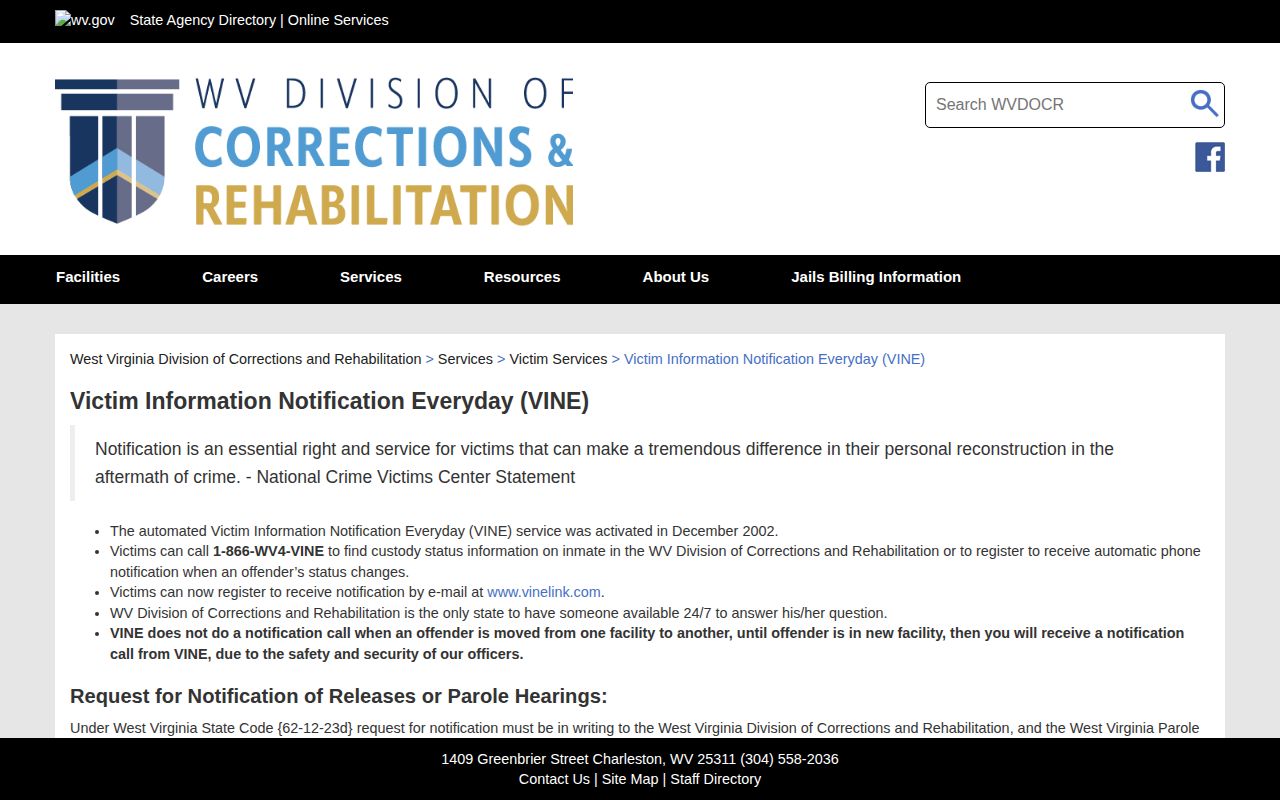
This state source confirms that VINE is an alert layer for WVDCR and the regional-jail route, not the court order or certified release log itself.
A reported released or out-of-custody result means the reporting agency sent a custody change. It may not state whether the reason was bond, time served, sentence discharge, parole, or another event. It also does not rule out a second hold or supervision. Use the reporting agency as the starting point for confirmation.
Search Grant County VINELink Records
Begin at VINELink and select West Virginia before entering personal details. The state choice matters because the same name may appear in more than one jurisdiction. For a Grant detainee, look for PHRJCF or another WVDCR location as the reporting agency or facility. For a state prisoner, expect a WVDCR prison rather than the regional-jail label.
- Open VINELink and select West Virginia from the jurisdiction choices.
- Choose the offender or person search and enter the name or identifier offered by the live form.
- Compare the result's agency, location, age or date of birth, and offender number. Do not select a name-only match.
- Open the matching record and read the custody status, reporting location, and event or date supplied.
- Save the agency and event details needed to ask PHRJCF, DCR, or the court for confirmation.
Multiple results require a slow match. A middle name, age, offender number, and location can separate people with similar names. If no current result appears, do not infer release. Search scope, spelling, data lag, transfer, sealed information, or a different custody system may explain the absence. The Grant County released-inmate lookup covers the wider source chain for a person who cannot be found in VINE.
Note: A Grant arrest may lead to PHRJCF in Hampshire County, so do not reject the match merely because the jail is outside Grant.
Grant County VINELink Release Fields
VINELink presents data received from a participating agency. The precise live labels can change, so read the current result rather than expecting a fixed layout. West Virginia research supports name or identifier searching, agency or location, custody status, and an event or date when supplied. Match all available identity fields before connecting the record to a Grant case.
| VINELink item | What it supports | What it does not settle |
|---|---|---|
| Name or offender identifier | Helps select the intended person | Identity by name alone |
| Reporting agency or location | Shows which participating custodian supplied the event | Every prior or later custodian |
| Custody status | States the agency-reported status shown at access | The legal reason for release |
| Event and date, if supplied | Dates the reported custody change | A certified exit time or complete case history |
| Notification option | Lets the user register for offered future events | Guaranteed immediate delivery |
A released status and an open criminal case can both be correct. VINE describes custody, while the court docket describes the prosecution. Someone released on bond may still have hearings and conditions. Conversely, a record that says transfer reflects movement, not community release. Obtain the PHRJCF release or transfer entry for the timestamp and destination, and obtain the signed court order for the legal authority.
Set Grant County Release Alerts
Register only from the correctly matched person record. West Virginia's official VINE page confirms telephone notification and email registration through VINELink. Other channels should be used only when the live West Virginia interface offers them. Registration follows the event options shown for that record and does not change the custody status.
- Open the matched result and choose “Get Notified” or the current registration control.
- Select an offered phone or email channel and enter accurate contact details.
- For a telephone alert, create a four-digit PIN if the interface requests one. Use it to acknowledge an automated event call and stop repeats.
- Complete any verification link or code sent for the selected channel.
- Keep the agency, person identifier, and registration confirmation so the alert can be matched to the correct record.
The VINELink interface is the source for the current search and notification flow.
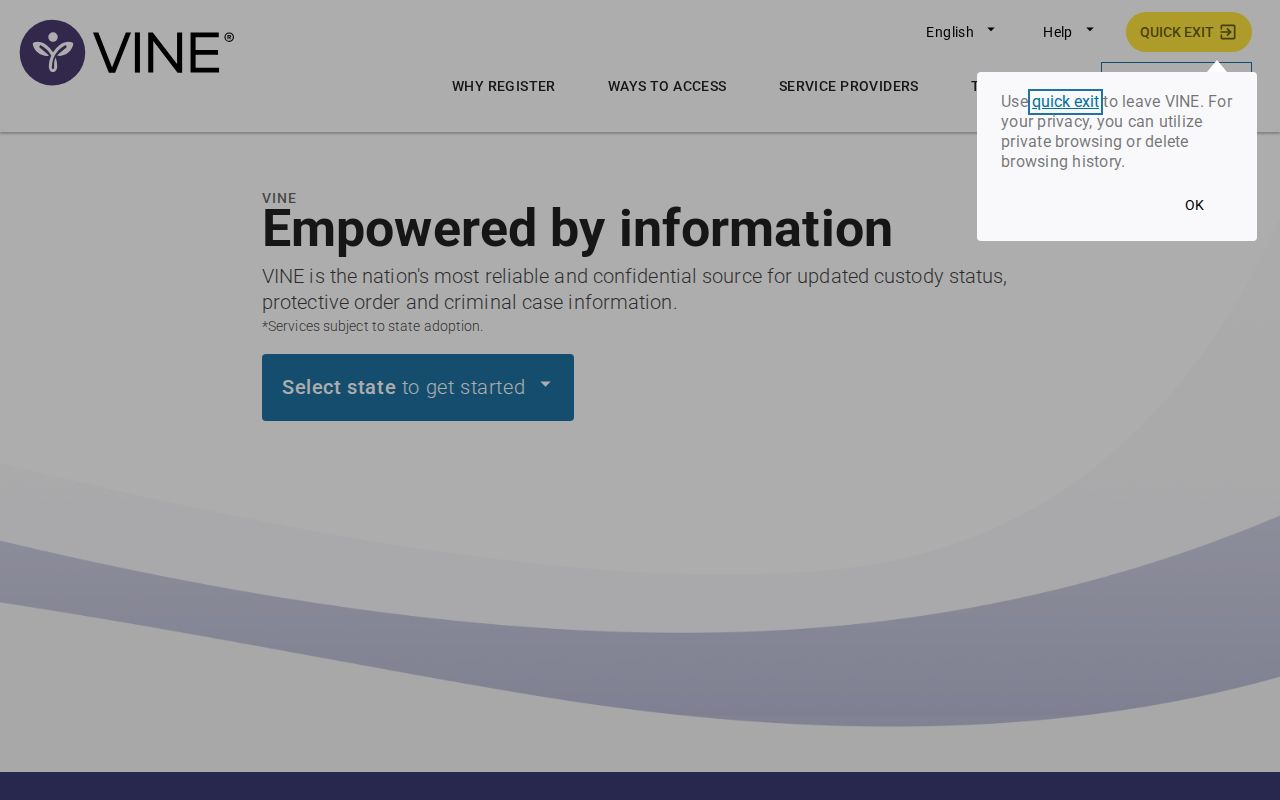
The captured interface demonstrates the online entry point; channel choices and confirmation steps must still be read from the live West Virginia sequence.
Telephone custody information and registration are also available through WV VINE at 1-866-984-8463. VINELink assistance is listed at 1-866-277-7477, with continuous support according to the service help page. Do not state that email uses a PIN unless the live form shows that requirement. The four-digit PIN is tied to phone-call acknowledgment in the supported workflow.
Confirm Grant County VINELink Releases
VINE does not guarantee perfect accuracy, completeness, or timeliness. DCR also delays a transfer notice until the person reaches the receiving facility for officer safety. A quiet interval can therefore occur during movement. Do not relabel that gap as release. When VINELink reports a custody change, ask the reporting facility for the releasable release or transfer entry and check the Grant court case for the order.
For a PHRJCF event, call 304-496-1275 and ask whether public information can distinguish release from transfer. A records request can seek the booking number, facility, release or transfer time, case identifiers, disposition code, and receiving agency. For a state-prison term, request the discharge certificate or final time sheet from DCR Records after an actual release. A current prison-search projected date remains an estimate.
Federal and immigration custody require separate systems. BOP's locator covers sentenced federal custody and may show “Released” or “Not in BOP Custody.” ICE has its own detainee locator. USMS has no equivalent public historical released-prisoner tool. A person leaving PHRJCF for one of those agencies has transferred, even though the regional-jail custody ended.
Note: A no-result in VINELink is inconclusive; check the likely custodian, the court case, and the underlying release or transfer record.
Grant County VINE Notification Layers
West Virginia's local layer has a crucial structure. VINE reaches all ten regional jails, so it follows the PHRJCF route used for Grant detainees. Yet WVDCR and the West Virginia Parole Board are separate entities. A VINE custody registration does not become a request for every Parole Board notice, and a Board notice does not replace confirmation of the physical DCR release.
For written victim notifications, DCR says release and parole-hearing requests must be submitted to both entities under their separate processes. A written notification request to DCR also enrolls the requester in VINE. This division explains why an alert, hearing notice, and release document can arrive through different offices while all concern the same person.
The transfer-delay rule belongs in this layer too. DCR withholds the VINE transfer notice until arrival at the destination. That safety measure can make a person appear unchanged or unavailable between facilities. Once the receiving entry appears, classify it as transfer unless the records show community release. The distinction protects the accuracy of both the custody account and later court work.
Read Grant County Release Status
Custody terms answer different questions. Use the label shown and resist turning it into a broader claim. A process flow helps: arrest and booking, PHRJCF custody, release or transfer event, possible community supervision, then eventual discharge from supervision. VINELink focuses on the custody-event portion of that chain.
- Released or out of custody
- The reporting agency transmitted that custody status. Confirm the reason and destination.
- Transfer
- Custody moved to another facility or agency; the person was not necessarily released to the community.
- Parole
- Conditional community release from a sentence under WVDCR supervision after a Parole Board decision.
- Probation
- Court-ordered supervision that is separate from DCR parole and may follow a jail exit.
- Discharge
- The relevant sentence or supervision term ended through the proper agency process.
A PHRJCF release on bond can leave the case open. A state-prison release can begin parole or mandatory supervision. An ICE or USMS handoff ends the regional-jail location but not custody. VINELink becomes most useful when its event is matched to this broader record chain rather than read alone.
Resolve Grant County VINE Conflicts
When records disagree, match each question to the office that creates the fact. The PHRJCF release or transfer log controls the physical custody event at that jail. A signed Grant court order controls bond, dismissal, sentence, or probation. A Parole Board order controls a parole decision. DCR Records controls the time sheet and discharge certificate. VINE remains an alert that transmits agency data.
If VINE says released while the court case stays open, bond or another pretrial event may explain both facts. If VINE says released and PHRJCF says transferred, ask which reporting agency and event the status represents. If the person disappears from VINE, search scope or lag may be responsible. Record what was checked, the access time, the matched identifiers, and what confirmation remains missing.
A sound release statement includes the matched person, facility, actual date and time when supported, release versus transfer type, authority, destination category, and later supervision when relevant. Until those points align, describe the VINELink result as an agency-reported status rather than a final legal conclusion.
That phrasing keeps the custody claim within the source's true scope.