
Grant Projected Release Dates
A projected date is a live calculation, not proof that someone left custody. The West Virginia Division of Corrections and Rehabilitation search gateway directs users to separate jail and prison tools. Government guidance for the prison result says its “More Info” view can display the exact label “Projected Release Date.” That field estimates the state-prison exit under the sentence and credits then recorded. It should be copied with the date it was viewed and kept in the future tense.
An actual Grant County release is a completed event. PHRJCF or another WVDCR facility creates a release or transfer entry when custody changes. A discharge certificate can document a completed state sentence. Parole papers document the Board's decision, but a grant may come before physical exit. A court order may authorize bond, time served, dismissal, or probation, yet another case or hold may keep the person confined.
Grant Release Date Labels
West Virginia uses several terms that can look alike in a search result or case file. Reading the label prevents a parole eligibility date from being reported as the date someone came home. The source that computes each field also matters.
| Label | Meaning | Best confirmation |
|---|---|---|
| Projected Release Date | Current WVDCR prison estimate shown in “More Info” | Recheck the prison record, then obtain the final release entry |
| PED | Parole eligibility date, when consideration may begin | West Virginia Parole Board records |
| Minimum discharge/final release date | WVDCR time-sheet calculation that can change with credit | DCR Records and the final time sheet |
| Release or transfer date | Recorded exit from one facility | Facility log showing destination and receiving agency |
| Discharge date | Completion documented by the corrections authority | Discharge certificate and matched court record |
PED does not create a right to parole. West Virginia Code §62-12-13a makes that limit explicit. “Released from a facility” can also mean transfer to another jail, prison, ICE, or USMS. The destination field resolves that difference.
Find Grant Inmate Release Dates
Start with the system that now holds the person. PHRJCF serves Grant County jail cases, but it is in Augusta and is operated by WVDCR. A person committed to a state prison may be placed anywhere in West Virginia. Federal and immigration custody use separate locators.
- Match the complete name with date of birth, OIS or booking number, and court case number. A shared name is not enough.
- Open the WVDCR gateway. Choose the prison search for a sentenced state prisoner and the jail search for a current regional-jail detainee.
- For a prison match, open “More Info.” Record the exact “Projected Release Date” field, current facility, and access date.
- For a Grant jail sentence, obtain the judgment and ask PHRJCF for the OIS sentence calculation. A pretrial case instead turns on bond and court action.
- Search Grant Magistrate and Circuit Court records for the order, credited days, concurrent or consecutive terms, and any later change.
- When the date arrives, confirm the actual release or transfer entry through the facility, VINE, and the receiving agency if one is named.
The complete Grant County search and records path is on the released-inmates home page. When a public prison result disappears, request the discharge certificate rather than treating the missing record as proof of release.
Grant Release Good-Time Rules
West Virginia Code §15A-4-17 supplies the main good-time framework for eligible adults committed to DCR. An eligible person earns one day of good time for each day physically incarcerated, including presentence jail days that the sentencing court credits. Credit comes off the maximum term of an indeterminate sentence or the fixed term of a determinate sentence. It does not accrue while the person is on parole, bond, or another non-incarcerated status. Life sentences do not receive this statutory good time.
Consecutive sentences are combined for the calculation. Misconduct can cause forfeiture, and the commissioner may restore credit. Approved meritorious service or a qualifying nonrequired education or vocational program can add credit under the statute's limits. WVDCR must give the inmate a computation statement and revise it when forfeited, restored, or added time changes the earliest discharge.
The official statute page shows the detail behind Grant County sentence calculations.
View the West Virginia good-time statute as the source for eligibility, credit, forfeiture, restoration, and supervision conversion.
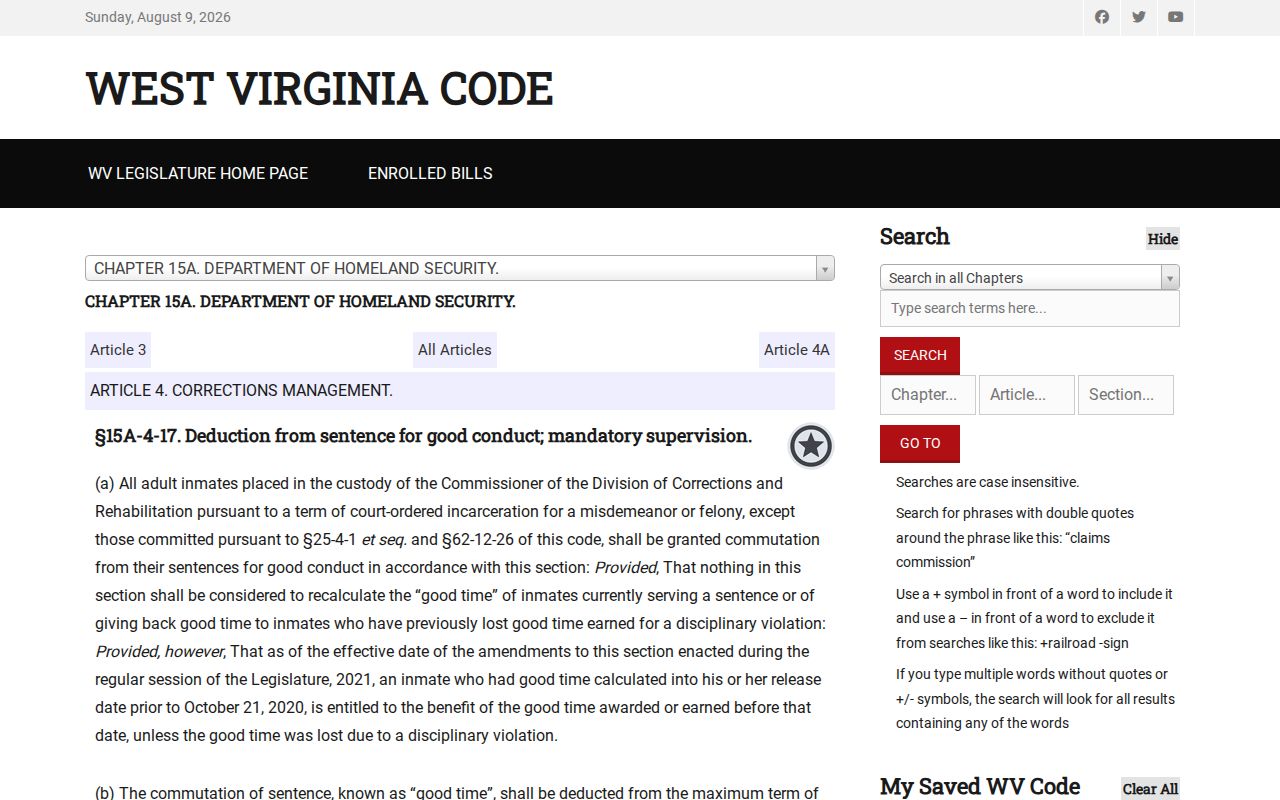
The captured law is a rule source, not an inmate calculator. Only the official time sheet applies the sentence, credited days, and revisions to one person.
No General Grant 85% Rule
The research found no general West Virginia statute requiring every state prisoner to serve 85 percent of a sentence. Importing that federal shorthand would produce false Grant County release estimates. West Virginia instead combines §15A-4-17 good time with offense-specific minimums, firearm restrictions, rules for life terms, court-ordered jail credit, discipline changes, parole thresholds, and mandatory supervision.
For certain felonies involving violence, firearms, or minor victims committed within the statute's scope, subsection (k) takes one year from accumulated good time to form one year of mandatory post-release supervision. For other felonies, subsection (l) permits a court to order up to 180 days served through mandatory supervision. Physical release may therefore begin supervision rather than end the sentence.
Note: Grant County release estimates should follow the inmate's official time sheet, never a percentage borrowed from another jurisdiction.
Why Grant Release Dates Change
A projection can move before the expected day. The change may be lawful and correctly entered, or it may reflect data lag. A passed date calls for a new source check, not an assumption that the person is free.
| Factor | Effect on the date | Record to check |
|---|---|---|
| Good-time forfeiture or restoration | Moves the earliest discharge later or earlier | Revised WVDCR time sheet |
| Added approved credit | May move the calculated date earlier | Credit approval and revised statement |
| Consecutive or amended sentence | Changes the term being calculated | Signed court order and time sheet |
| Detainer or outside hold | May cause transfer instead of community release | Facility destination and receiving agency |
| Parole decision | Creates a possible supervised path, not an instant exit | Parole Board order and DCR release entry |
| Search delay or correction | May make the displayed field stale | DCR Records response |
A parole grant from a regional jail has a specific local wrinkle. The Parole Board FAQ says the person first transfers to a DCR facility for intake and fingerprinting and advises allowing seven to ten days before release. Record the grant and physical exit as separate events.
Parole eligibility adds another source of confusion. Under §62-12-13, the usual threshold relates to the minimum term of an indeterminate sentence or one quarter of a definite term, but special offense rules and exclusions can apply. Eligibility opens the Board's review process. It does not replace WVDCR's projected date, compel a favorable decision, or state the day the facility will complete release processing.
Detainers require the same care. A court may finish one Grant case while another county, state, federal, or immigration agency still has authority to take custody. The regional jail's destination or receiving-agency field is therefore as important as the date. If the record names a new custodian, use that agency's locator and describe the event as a handoff.
Grant Jail Release Calculations
Not every Grant detainee has a sentence-based projected date. A person held before trial may leave after bond, dismissal, acquittal, or another valid order. Those events depend on court action and facility processing, not good-time arithmetic. A definite jail sentence depends on the judgment, effective date, credited days, and the OIS calculation used by PHRJCF.
Search both Grant court levels where appropriate. Magistrate Court handles bail, misdemeanors, and preliminary felony matters. Circuit Court handles felony prosecution and general jurisdiction. A case can begin under one number and continue under another. Obtain the signed order and match it to the facility record. Even a time-served order on one charge does not cancel another warrant or detainer.
For time-sheet, PED, jail-credit, and good-time questions, the Parole Board contact page directs requests to DCR Records Manager Richard Doss, 1409 Greenbrier Street, Charleston, WV 25311, at 304-558-2036.
PHRJCF's own release work adds a processing stage after the legal authority arrives. Policy 457.02 calls for staff to identify the person through file and OIS photographs and other identifiers, then match the eligible date, case numbers, charges, and issuing authority to a valid document. Felony expiration requires a verified Central Office discharge certificate. Misdemeanor expiration uses the OIS calculation. Parole and special programs require their own signed and verified papers. A docket event can therefore precede the recorded exit.
No public facility-specific release hour was found. Policy 457.09 permits a jail releasee to call family or friends to arrange transportation, and the general policy addresses transportation when lawful release occurs without another plan. Because PHRJCF is outside Grant County, call the facility before travel. A projected day alone does not promise a pickup time or exit door.
Confirm Grant Actual Release
On or after the projected day, reopen the live WVDCR record. Check the jail and prison channels for a location change. A VINE event can add timely notice, but VINE remains an agency-fed alert rather than a certified reason for release. The Grant VINELink release check explains how to register for one person's custody change.
Ask the facility or DCR Records for the release or transfer date, time, authority, destination category, and receiving agency. A discharge certificate or final time sheet is strongest for completed state custody. If the entry names ICE, USMS, another jail, or a prison, continue with that system and describe the event as a transfer. If the date passed with no clear event, request a revised time sheet and do not convert the projection into history.
Create a short source log when records conflict. Note the exact field, system, access date, matched identifiers, and any error message. The signed court order controls the sentence or bond it imposed. WVDCR controls its time sheet and physical custody event. The Parole Board controls its decision, while VINE reports a downstream agency-fed change. Matching each question to its source often resolves what first looks like a contradiction.
Note: The court controls its order, while WVDCR controls its calculation and physical custody record; both may be needed to settle one date.