
Grant County Parole Versus Probation
Parole and probation both permit life outside a jail or prison under stated rules, but they arise from different authorities. The independent West Virginia Parole Board decides parole and revocation matters. WVDCR Parole Services supplies the field officers. Ordinary Grant County probation is imposed through the court and supervised by the West Virginia Judiciary. A DCR parole result should not be used to decide whether a person is on court probation.
| Point | Parole | Probation |
|---|---|---|
| Who creates it | West Virginia Parole Board after a prison sentence | Sentencing court |
| Who supervises it | WVDCR Parole Services | Judiciary probation office |
| Core record | Board order plus DCR release and supervision record | Judgment or probation order plus court docket |
| Public lookup | DCR offender gateway and Board contact, with no verified person-level decisions database | No official statewide public person-level probation lookup located |
| How it ends | Expiration or formal parole discharge | Completion or court discharge order |
- Parole
- Conditional release from prison custody under a Board decision, followed by state field supervision.
- Probation
- Court-ordered community supervision that does not require a prior parole grant.
- Absconder
- A person reported as failing to remain in contact or comply with supervision, subject to official confirmation.
- Discharge
- The formal end of a custody or supervision obligation shown by the agency with authority.
Home confinement is different again. Grant County's Sheriff administers a local electronic-monitoring program under court authority. Physical departure from PHRJCF for that program is not unconditional sentence completion and does not make the participant a parolee.
Verify Grant County Post-Release Supervision
Begin with a matched person and a matched case. A full name alone is weak, especially where the name is common. Use the date of birth, court case number, OIS number, and releasing facility when lawfully available. The legal order shows whether the status is parole, probation, home confinement, or another form of supervision. The field office then confirms which unit is responsible, subject to limits on protected operational details.
The official WVDCR Parole Services overview identifies the state field-supervision system.
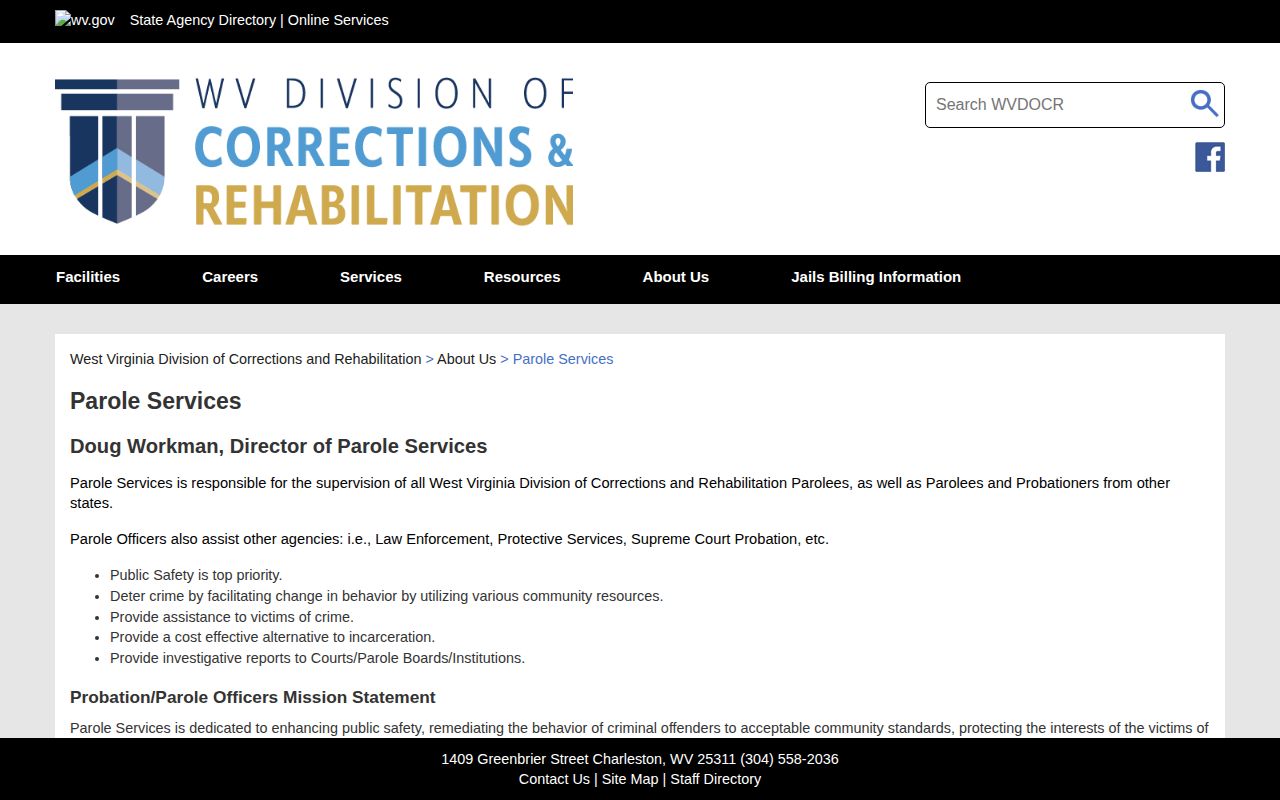
That state source applies to parole, while ordinary Grant County probation remains with the Judiciary and local probation office.
- Search both Grant Magistrate and Circuit Court records, then obtain the signed sentencing, probation, revocation, or discharge order from the clerk.
- If the order or prison record shows parole, contact the West Virginia Parole Board for the decision and WVDCR Parole Services for field assignment.
- If the order shows probation, contact the Grant County Probation Office rather than a DCR parole office.
- If the order shows home confinement, verify the effective terms with the court and the Grant County Sheriff's program.
- Check the WVDCR Escapees and Absconders channel only for a supported supervision concern, then confirm any match with the responsible office.
- Request the formal discharge order when the question is whether supervision has ended.
The Grant County released inmate search and release-record path explains how to match the supervision order to the PHRJCF or DCR physical exit record.
Grant County Parole Office Assignment
Grant County appears in Northern District, Region 7 of WVDCR Parole Services. The official pages for both the Moorefield and Martinsburg offices list Grant among the counties served. No public person-to-office assignment search was located. A caller should not select an office based only on the person's home address. Ask either office to identify the unit holding the case.
The official Moorefield Parole Office page is captured below.
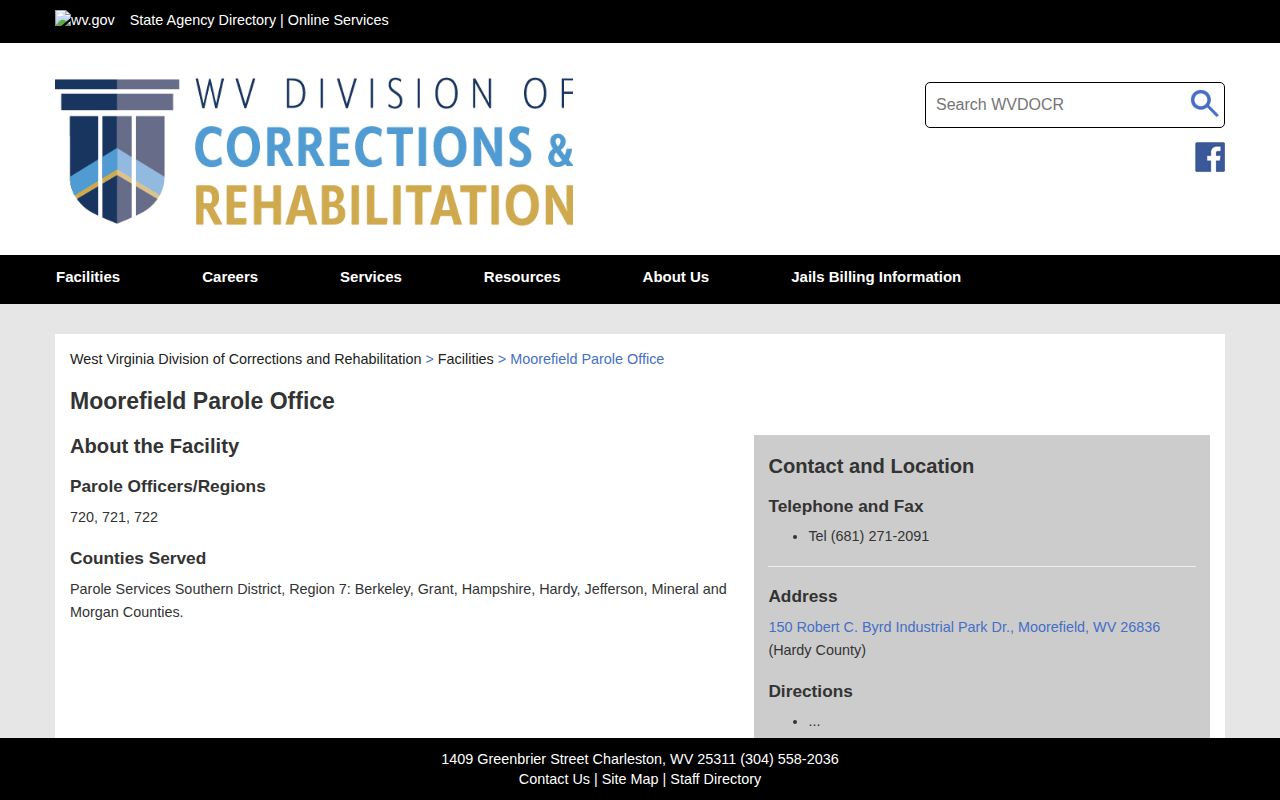
Its Grant County listing must be read alongside the Martinsburg listing, which is why direct assignment confirmation is necessary.
Moorefield Parole Office
150 Robert C. Byrd Industrial Park Drive
Moorefield, WV 26836
681-271-2091
Martinsburg Parole Office
1520 Winchester Avenue
Martinsburg, WV 25405
304-267-0055
For probation, the official Judiciary directory lists the Grant County Probation Office at 5 Highland Avenue, Petersburg, WV 26847, with telephone 304-530-5660. Confirm the sentencing case with the Circuit Clerk first. No office hours were published in the research, so none should be assumed.
Note: An office may confirm routing while withholding a person's private schedule, residence, or other protected operational details.
Grant County Parole Hearing Records
The West Virginia Parole Board schedules an eligible inmate in the month of eligibility and normally conducts hearings monthly for each institution. Its calendar is organized by facility, not Grant County. On the research date, the linked calendar still displayed April through June 2026, so the visible file was stale. The Board should be called at 304-558-6366 to confirm the current schedule.
Eligibility is not release. Under §§62-12-13 and 62-12-13a, the usual starting threshold is the minimum term of an indeterminate sentence or one quarter of a definite term, with important offense-specific rules and exclusions. The law expressly says an eligibility date creates no right to release. No official public person-level decisions search was found. Supported outcomes include grant or denial, while revocation proceedings can result in reinstatement, new conditions, revocation, or abeyance.
The Board homepage stated that parole interviews were being held by video conference until further notice and that in-person public attendance was unavailable. Another hearing page retained mixed language. Confirm the format by phone. Board audio requests are a separate records channel, not proof that physical release occurred.
Grant County Parole Release Delay
A Board grant is not a same-day release signal for a person at a regional jail. The Board FAQ states that a person granted parole from a regional jail first transfers to a DCR facility for intake and fingerprinting. It advises allowing seven to ten days before actual release. That is a Grant County-specific verification issue because PHRJCF is a regional jail.
Record the Board grant date and the DCR physical-release date as two separate facts. A detainer or another prerequisite may also affect timing. Use the Board for its decision, DCR Records or the facility for actual exit, West Virginia VINE for the custody event, and Parole Services for the field-supervision assignment. If the record names another custodian, describe a transfer rather than community release.
Note: PED means parole eligibility date, not a promised hearing, grant, or physical release date.
Grant County Parole Absconder Checks
The WVDCR offender-search gateway includes a statewide Escapees and Absconders channel. It is not a Grant County warrant list, and the live fields and update schedule could not be verified during research. A matching absconder entry signals an unresolved supervision or custody issue. It does not show a routine discharge and should be confirmed through WVDCR or the responsible law-enforcement agency.
A court docket may also show a probation revocation filing or warrant. That legal event belongs to the court record, while the probation office holds the active field assignment. West Virginia VINE may report custody changes after an arrest, but it does not replace the revocation order or prove that supervision ended. The same care applies when a person disappears from the public prison or jail search.
Grant County Supervision Conditions
Conditions come from the controlling Board or court order. They may direct reporting, travel approval, treatment, testing, electronic monitoring, payment duties, or compliance with law, but the exact terms must be read from the person's actual order. A violation allegation is not the same as a final revocation. The Board or court decides the legal outcome after the applicable process.
For Grant probation, use the Circuit Court docket and probation office. For parole, use Board records and WVDCR Parole Services. For home confinement, use the court order and Sheriff's monitoring program. Mixing these systems can lead to incorrect labels and missed records. It can also cause a routine office change to be mistaken for absconding.
Question: Does VINE show all supervision changes? No. VINE is an agency-fed custody notification layer. It can alert to a reported event, but the responsible Board, court, or field office controls supervision status.
ID After Grant County Supervision Starts
West Virginia provides a practical document route for some eligible DCR releasees. Under W. Va. Code §17B-2-1c, DCR may issue a no-cost temporary identification card during the seven days before release. It is valid for 180 days, and DMV must accept it for the specified identity, age, and residency proof. DCR's property policy also keeps existing licenses, Social Security cards, and other identity papers in the legal file for release.
This process is separate from supervision verification. The card can support reentry tasks, but it does not prove whether the holder is on parole, probation, or discharged. Corrections to a Grant court disposition go to the clerk. Corrections to DCR custody dates go to DCR Records. The office that created a source record remains the right place to correct it.
Ending Grant County Post-Release Supervision
Physical release from PHRJCF or a state prison starts the community phase when supervision follows. It does not itself end the sentence. A parole discharge can occur at expiration or through the statutory early-discharge process in §62-12-18. Some life parole cases have a minimum supervision period. Obtain the discharge order when a definite end date matters.
Probation ends according to the court's order and any later extension, modification, revocation, or discharge. Search the Grant Circuit Court case and request the signed final order. Home confinement likewise depends on the court and program records. A person no longer listed in a jail tool may still be under one of these duties.
When records conflict, match each question to its source. The facility proves physical exit. The Board proves a parole decision. The court proves probation. Parole Services or the probation office confirms the field assignment. VINE supplies a useful reported event, but not the final legal conclusion.