
Grant County Federal Custody Scope
The U.S. Bureau of Prisons holds people serving federal sentences and maintains the public inmate locator. It is not the Grant County jail, a West Virginia regional jail, or the federal court. A Grant County arrest does not create a BOP record unless the matter entered federal sentenced custody. Someone held for a federal hearing or transported under a federal writ may instead be managed by the U.S. Marshals Service and never appear as a committed BOP inmate at that stage.
The BOP inmate locator covers federal inmates from 1982 to the present. Search results can identify a person by a federal register number or another supported number, or by name with optional age, race, and sex fields. Results can show name, register number, age, race, sex, release date, and location or status. Those are federal fields. They do not describe a prior PHRJCF booking or a state-court disposition.
| Custody question | Correct source |
|---|---|
| Current or historical BOP custody | BOP inmate locator |
| Federal detention or release order | Federal docket and signed court order |
| USMS pretrial custody or transport | Federal docket and an appropriate USMS record request |
| WV regional-jail exit to federal custody | PHRJCF transfer entry naming the federal receiving agency |
Note: A Grant County connection does not place a person in BOP records unless the custody path reached federal sentenced imprisonment.
Search Grant County BOP Releases
Start with the strongest identifier. A register number is more precise than a common name, but the name search can work when the number is unknown. Use age, race, or sex only as match fields shown by BOP, and compare the complete result before selecting a person. A Grant residence or case link may not appear in the locator, so confirm the federal case separately.
- Open the BOP inmate locator and choose the number or name search.
- Enter the register number or the complete name and any supported narrowing fields.
- Compare the name, number, age, race, sex, and other displayed identifiers.
- Read the exact location or status and the release date shown.
- Save the access date and locator result, then match the register number to the federal docket.
- Check whether another agency or supervised-release term continued after BOP custody ended.
The BOP locator interface can be reviewed at its official source before interpreting a Grant County federal release.
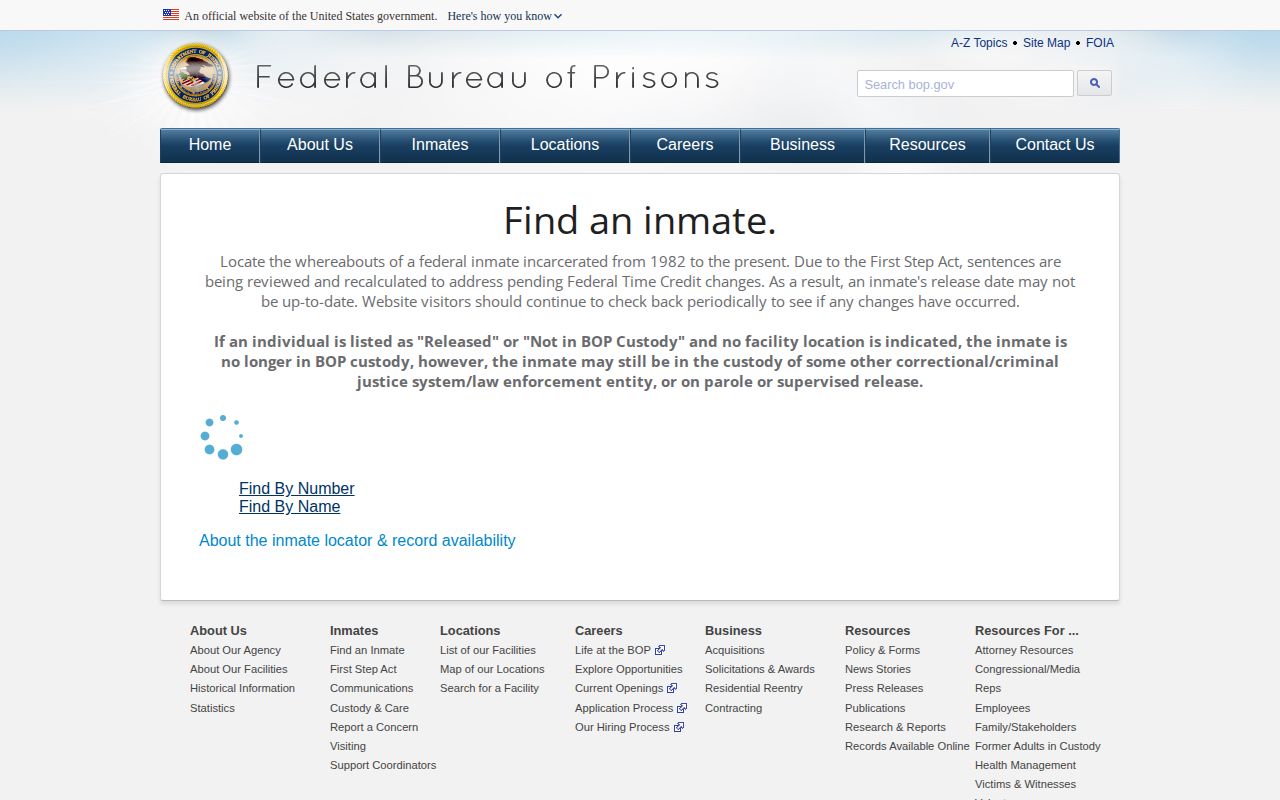
The captured result demonstrates the federal status labels and date context; it does not establish freedom from a state, ICE, or supervised-release obligation.
Read Grant County BOP Status
BOP expressly explains that “Released” or “Not in BOP Custody,” when no facility is listed, means the person is no longer in BOP custody. A past release date with no location also marks the end of BOP custody on that date. Keep the agency name in the conclusion. “Released from BOP custody” is supported; “free from all custody” is broader and may be false.
| BOP display | Supported reading | Remaining check |
|---|---|---|
| Named BOP location | Current reported federal prison location | Live status and court record |
| Released | BOP custody ended on the displayed date | Other custody and supervision |
| Not in BOP Custody | The person is no longer held by BOP | Federal docket or another custodian |
| Past release date, no location | BOP custody ended on that date | Reason and post-release status |
Federal supervised release is a court-ordered period after imprisonment. It is not BOP incarceration, but it means the federal sentence may still impose conditions. A person can also move to state custody or ICE. BOP warns that an individual may remain in another justice system after leaving its custody. The locator therefore answers an agency-specific question rather than every question about liberty.
Note: Preserve the exact BOP status wording because each label supports a different and carefully limited custody conclusion.
Grant County Federal Handoffs
A Grant County custody trail may begin at PHRJCF and later turn federal. The regional-jail release or transfer record should name the destination category or receiving agency. If that entry says USMS, it documents a handoff to federal custody management, not a community release. If the federal case later results in a prison sentence, BOP becomes the correct locator after commitment and designation.
Do not assume the handoff date is the BOP release date. The first is the date West Virginia custody passed to a federal custodian. The second ends BOP custody after the federal sentence period recorded by that agency. Between them, the federal docket can show detention, plea, judgment, sentencing, appeal, or release orders. Each system controls its own event.
- Federal remand
- A court orders detention while the federal matter proceeds.
- USMS custody
- The Marshals Service manages a federal prisoner before BOP commitment or during transport.
- BOP commitment
- A sentenced federal person enters Bureau of Prisons custody.
- Supervised release
- Court-ordered federal supervision follows imprisonment and is separate from BOP confinement.
The Grant County USMS custody page addresses the pretrial and transport stage, where no BOP-style public historical locator exists.
Verify Grant County Federal Release
The federal docket supplies the legal context missing from the locator. Use PACER, the federal courts' records gateway, to find the case by party or case number and obtain the judgment or release-related order. Nominal access fees may apply within that system, but the research does not establish a page-specific amount to publish here. Match the BOP register number, name, and case details before joining the sources.
Read the judgment for the term of imprisonment and supervised release. Later docket entries may record a modification, revocation, or another legal event. BOP also warns that First Step Act recalculations can make projected dates temporarily inaccurate. That makes the historical Released label and the signed court record more useful for a completed event than an old projection copied before the date passed.
When dates differ, record the label attached to each one. A sentencing date is not the prison entry date. A projected date is not the actual release date. A BOP release date does not automatically end supervised release. Clear labels allow all three dates to remain accurate without forcing them into one unsupported event.
Note: Use the federal docket for the court's action and BOP for the agency's custody status; neither substitutes for the other.
Federal BOP Release Record Fields
A complete verification log should preserve the exact BOP result and the court source used to explain it. Avoid unnecessary personal detail. The goal is to identify the custody transition, not build a broad profile. A name-only match is weak; a register number and corresponding court case create a much firmer link.
- Full name and BOP register number
- Displayed age, race, and sex used to confirm identity
- Displayed location or exact custody-status label
- BOP release date and locator access date
- Federal court and case number
- Judgment or later order relevant to release and supervision
If the public result is unclear, keep a source log of the search terms, identifiers, access date, and message shown. An absent result can reflect a spelling issue, wrong system, pre-1982 custody outside the locator's stated span, or a person who never entered BOP custody. It does not prove there was no federal detention or USMS movement.
Older federal records need particular care because the locator's stated public coverage begins in 1982. A blank search for an earlier episode falls outside the supported historical range and cannot be read as proof that the custody never occurred. For a post-1982 result, preserve the exact BOP label rather than rewriting it. The difference between a named location, Released, and Not in BOP Custody is central to an accurate timeline.
Also separate release from a projection. BOP notes that sentence calculations can change, including during First Step Act recalculations. A projected date copied before it passes is not a completed release. Reopen the result, record the current status, and use the federal docket when the legal sentence or later supervision must be explained.
Resolve Grant County Federal Conflicts
Source conflicts often disappear when each record is kept within scope. PHRJCF can correctly report transfer to USMS. A federal docket can correctly show a pending case. BOP can later report Released. None necessarily contradicts the others because they describe different agencies and stages. Order the events by date and retain the agency attached to each.
If BOP says Released but ICE lists current detention, describe the person as released from BOP and currently in ICE custody if both identities are fully matched. If BOP says Not in BOP Custody while the docket orders supervised release, say BOP imprisonment ended and federal supervision remains under the order. If the BOP locator has no result but a federal detention order exists, check USMS custody rather than inventing a BOP history.
The Grant County released-inmate search explains how a West Virginia record leads into the federal chain. The decisive habit stays the same: identify the creating agency, match the person, classify release versus transfer, and preserve the source date.
Note: When the next custodian is unknown, report only the verified end of BOP custody and identify the unresolved point.